ampersandology: film. culture. words.

Showing posts with label nostalgia. Show all posts

Sunday, November 14, 2010

Gone With the Awesome

by Jillian Butler, Ampersandology

On the day the word "outstanding" was redefined, I simply stood in awe and watched. 


Like...okay. 


This is awesome. Today is a day I love people, espeically people who make fan vids of old 1930s epics with crappy pop songs. 


Intellectually, I know there are several things wrong with this video. One, Avril Lavinge. Two, Scarlet's inability to build a bridge and get over that foppish whelp Ashley Wilkes already. Three, not nearly enough Rhett. Four, Scarlet's such a fierce bitch, why does she even LIKE Ashley? Five, Rhett. Six, like seriously O'Hara, he's a hardcore ginger! And not the good kind. 


But intellectually don't get you squat diddly in the proud hall of the Pop Culture UnfortunatesFor the record, Melanie Hamilton is like so whatever. What a do-gooder wet blanket. Stop wearing your hair like a helmet, Melanie. And stop marrying your cousin. 


My enjoyment of this wondrous video very much like my love of Gone for the Wind itself. Basically, my head says, "ooooh problematic romanticism of race and class!" and my heart* is all "wheeeeeeeeee curtain dresses and really big hats!" If it's on, I will stop everything and watch it, despite that I would put the gross estimate of my viewings thus far at ABOUT FORTY TIMES. For kicks, I quote obscure lines from this movie TO MYSELF constantly, despite the fact no one on earth (except maybe Spike Lee) will understand. What? I don't have a TV, okay? 


Look, I'm not saying two wrongs make a right. I'm just saying you're going to have to forcibly remove the part of my brain that loves everything about this crazy racist movie. 


The only thing I enjoy more than the above video is perhaps the suggestion that my beloved Tallulah Bankhead was considered for the role of Scarlett O'Hara:  


Then again, it seems every actress working in Hollywood at the time was considered during "The Search for Scarlett"--a very clever marketing gimmick for the studio to build excitement about a movie that wouldn't be made for years (and was plagued by trouble when it was). In truth, there were only three or four actresses that were ever seriously considered, but, the mythology surrounding the search is more than tempting--a cross-nation search with the old-fashioned grandeur of the 42nd Street Moment. How funny then, that the part went to a British actress. Still, Bankhead would have been INCREDIBLE as Scarlett. Absolutely wrong for the part, but INCREDIBLE. Woulda, coulda, shoulda.

Oh no. I just found the Lady Gaga remixes. There's no turning back now. 


*or the angry fist where my heart should be. Wevs!


Have a suggestion for a future Ampersandology topic? Got something you’d like to say? All feedback welcome! Shoot us an email at ampersandology@gmail.com, or follow Ampersandology on Facebook

Wednesday, July 14, 2010

Great Stars and Their Last Films


by Jillian Butler, Ampersandology


There's one film that leads the discussion of Famous Last Films, and that's The Misfits (1961). Arthur Miller originally wrote the screenplay as a Valentine's Day present to his then-wife Marilyn Monroe, and in the years since, The Misfits has acquired a misty nostalgic sheen to it; it stands as a kind of talisman that film buffs can point to and say, "Look. Here. This is when the change started."


Whether or not that's accurate, it certainly is a tempting mythology. Starring Monroe, Clark Gable and Montgomery Clift, the entire production seems like cinematic kismet, as the film details the efforts of an aging cowboy (Gable) to rustle up mustangs to sell, while befriending an aimless divorced woman (Monroe) and rodeo drifter (Clift). Here, the symbolism starts to work overtime: the horses are sold for dog food, but the cowboy can remember the days (the good old days, in case you were wondering) when these same horses would be sold for children's fairs.

All three of its stars were approaching the end of their careers, though of course none of them knew it: Gable was a lifelong alcoholic and would collapse from a heart attack two days after filming; Clift, whose had only escaped his matinĂ©e idol good looks by being uncommonly talented, had been very badly disfigured in a motorcycle accident some years before and had never quite found his footing in Hollywood after that.

And then, of course, there is Marilyn Monroe, whose troubled life have filled a thousand pages of a hundred books far more impressively than I could attempt here; I will mention, however, that she had to attend the film's premiere on a pass from the psychiatric ward she had checked herself into for narcotics abuse.

Gable, who'd begun his career as an extra in silent films, was one of the last leftovers from the studio system, one of the last holdouts of the traditional, stoic masculine screen image that actors like Clift had fought hard to reinvent. Watching him in The Misfits is a little like witnessing the end of an era. And it's not just Gable: in their own ways, both Monroe and Clift were also the last of their kind, both raised in a largely studio-based Hollywood system that would begin to crumble in just a few years.

It's hard to watch The Misfits without all of this in mind; I tend to judge it as a haunting punctuation to three bright and troubled lives. Is this always the case, I wondered? It's a morbid tendency I've always nursed: the minute I hear that a famous Hollywood name has passed on, it's usually my first instinct to check their IMDb page for the last movie they completed.

Why? I'm not entirely sure, though I think it may have more to do with my need for symmetry. It touches me deeply when a star's last film provides some kind of symbolic closure on a life lived in the public eye; it disturbs me greatly when it seems arbitrary, or happenstance. 

Discuss! 


Audrey Hepburn - Always

 By 1989, Audrey Hepburn had begun the slow descendant of a successful star on the downswing; after her Oscar-nominated turn in 1967's Wait Until Dark, she worked only occasionally while raising her family or promoting the charities closest to her heart (as a child who'd grown up in the Nazi-occupied Netherlands, the plight of impoverished children hit her especially hard). In a career marked by style, charm and gamine grace, this treacly remake of 1943's A Guy Named Joe is an oddity on an otherwise impeccable resume.

Hepburn plays an angel to Richard Dreyfuss' downed airline pilot, and her charming, ever so maternal grace is a comforting distraction. The first clue to the film's general quality is how many genres it straddles: billed as a romantic comedy drama, Always strikes me as a jack of a couple of trades, but master of none. Also, many critics consider it a direct forefather to Ghost, so at least we know who to blame for this:


Monday, June 7, 2010

A Boy and his Ursine: Fictional Bears Throughout Culture


by Jillian Butler, Ampersandology


This post is dedicated to my friend Adam, whose love of bears and bears-related topics inspires me almost every day (...that he mentions this passion). 


While I never forgot that Lord Byron owned a pet bear, I did forget the reason he got it. 


It was because Cambridge wouldn't let him get a dog. Badass. He later suggested that the bear apply for a college fellowship. Badass. His ultimate goal was to make the bear his best friend. MOST BADASS OF ALL. 


Loose interpretation of the event. 


I wish Childe Harold's Pilgrimage had been about Byron and his bear roaming the English countryside and solving mysteries.  Not only would that make a much better poem, it has serious sitcom potential: like The Odd Couple, but with BEARS! 


Bears represent so much more than the last thing you'd want to meet in the woods. Especially in children's literature and film, bears become a great example of the place in the imagination where fear meets anthropomorphism: look no farther than the high quantities of "friendly" bears to tell us how much we like to paint the scary corners of our fears in bright colorful polka dots. 


Indulge me, if you will, to take a look back through the greatest bears of pop culture history. 


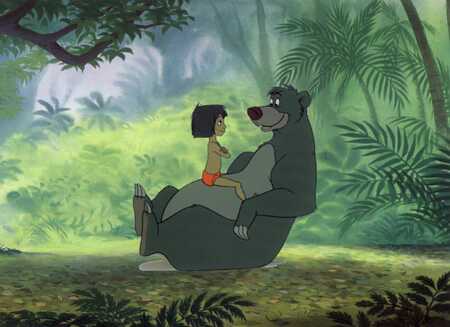
Baloo (The Jungle Book)


Troubling racial messages aside, Disney's The Jungle Book features one hep cat in the form of Baloo the bear. He sings, he dances, and BOY. Does he love honey. Some of the most bizarre imagery of my youth came from watching Baloo eat a mouthful of bees. Is honey delicious enough to warrant a tongue full of bee stings? The question haunted me so I didn't put on my food until age 17. Regardless, this laissez-faire attitude is what puts Baloo on this list: the "Bare Necessities" is less a runaway pop hit and more an anthem of a strangely-spartan hedonism.


In the original Kipling work, Baloo was basically the exact opposite of his screen portrayal. He was stern, and often used beatings and other punishment methods to get through Mowgli's thick human head. That backwards stiff has no business on this list. One stiff and disciplined, the other carefree and hip. Makes you think of the Wakefield twins, really. 


Paddington Bear
Let me tell you, it is HARD to pull off red and blue without looking like the political split down American soil. Paddington Bear does that and then some, managing to get himself adopted by humans and conforming to a charming British befuddlement. 


Smokey the Bear 


Did you YOU leave fire unattended in the forest? Yeah, I didn't think so. I sure didn't. Mostly because I don't ever go in the forest, but ALSO because of Smokey's simple, elegant threat against my well-being.


Fozzy Bear (The Muppet Show)
A beloved fixture from my youth, I still can't pinpoint why Fozzy Bear is so charming. Is it his fuzzy, over-sized digits? Perhaps it's his little cravat, making him both clownish and fancy in one fell swoop? Personally, I think it was the deep level of pathos he carried with every lame duck of a joke; he's a clown who's not funny, giving whatever laughter he earns the slight tinge of sadness. He's that one uncle who thinks you'll still laugh at the same joke you liked when you were two. Those guys are hard to shake. I know what a cow sounds like, Uncle Geoff. I'm 25. God.  


Sleeping Bear (Legends of the Fall)

Skip ahead to 1:20 to see the only bear that has EVER bested Brad Pitt. 


Bear Grylls
Convince me this man is real. You can't. I saw him use his own bloody fist as bait! BAIT! There is so much wrong with that sentence that it doubles back into right. Though I know at least one person that would disagree with me, Bear Grylls impresses me in the same moment I reach the dictionary to look up the definition of Batshit Crazy (verb, meaning to be foolish or impractical to the point of insanity; intensely involved with LAUGHING AT THE LIMITS OF THE HUMAN BODY). His mother was probably Hera or something, which makes him a demi-god, not a television host. Nice try, Discovery Channel, but you can't fool me twice! 


Wojtek the Bear 


Orphaned as a cub, this real-life bear was adopted by the Polish army and trained to transport ammunition, in addition to eating cigarettes, drinking beer, and --reportedly-- interrogating Nazis. Let me repeat that--this bear supposedly sat himself down across from Nazi spies and asked, "WHAT'S UP, BADDIE?" in Bear. To be fair, it's the move of a brilliant tactician--what wouldn't you tell a bear who's demanding a full confession? What a way to serve your country; did you hear that, Von Trapp family singers? Do re methinks you've been served. 

*

Got a favorite bear? Leave it. 


Have a suggestion for a future Ampersandology topic? Got something you’d like to say? All feedback welcome! Shoot us an email at ampersandology@gmail.com, or follow Ampersandology on Facebook

Monday, February 1, 2010

Butch Cassidy and the Worst Idea in the World

by Jillian Leigh, Ampersandology


I can't hold my tongue any longer. Tom Cruise is planning a remake of Butch Cassidy and the Sundance Kid and..well, there goes my last vestige of hope that my childhood would survive the New 'Aughts unscathed. Oh, and it gets better: John Travolta is set to take Paul Newman's part.

Yeah. I'll let that sink in.

Look. This isn't anything against Hollywood and their annoying tendency to throw money at bad ideas. This isn't even anything against Tom Cruise or remakes in general. This is a protest against trying to improve that which cannot be improved, AKA the Greatest Buddy Film Ever Made(tm).

This may come as a shock, considering the shiny purist hat I'm known to wear on occasion, but I don't think remakes are an inherently bad idea. I think that, if done with the right intent, remakes can be an amazing gauge for the fluid changes within a society. I've had a pet theory involving Invasion of the Body Snatchers (ask me more!) and the fact that every time it gets remade, it takes on the subtle paranoias dominant in culture at the time. There's been three or four versions so far, and every time, the tenor of the aliens doin' the snatching changes, evolving from Commie fears to hippie hatred to...well, whatever conglomerate it is that troubles us in the 2000s. I don't know, Nicole Kidman's pristine, creaseless forehead maybe? Anyway, the point is, it's like a Tabula Rasa that a filmmaker can use to overlay the concerns that pulse underneath the surface of a culture.

Remakes can be a handy tool, but usually only if there's a point to making them. As much as Disturbia bugged me as a pale imitation of the perfect Rear Window, it was still kind of neat to see the classic storyline interpreted using technology that probably spies on us more than we spy on each other. I've heard rumors of an upcoming remake of The Birds starring George Clooney and Naomi Watts, and I was excited, even with Michael Bay's name attached--it wouldn't be hard to update the "nature's revenge" in a way that resonates the same way it did in 1963, considering the hypocrisy that's found in a society that drops off the weekly recycling in the back of a gas-guzzling SUV. Plus, the caliber of the attached stars (Clooney and Watts)  made me hope for a smart reinvention rather than a lame grab for money.

Anyway, back to the main point: what is the real purpose behind remaking Butch Cassidy and the Sundance Kid for the 2000s, especially in its current Cruise/Travolta incarnation? I've gotten pretty good at reading the writing on the wall and I don't like what I see: Meet the Parents with cowboys. Cruise has already admitted he loved the movie as a kid, which literally makes him the worst possible choice to helm the remake.

That's not to say a remake couldn't work: give it the Deadwood treatment, and grunge up the already grungy lives of two affable outlaws. The original was admittedly light on the revisionist history angle, so you could play that up: not even cowboys lived like cowboys, after all. Try and work in something about the last frontier. Oh, and cast unknowns, as Robert Redford was at the time.

Otherwise, cast Brad Pitt and George Clooney. Those two could really use the money, you know, and they DO seem to get along. That's a remake I would proudly slide onto the shelf next to the original.

What do you think? Any remakes that you thought really worked? Or drove you crazy with their blatant wrongness?

Monday, November 23, 2009

The Clever Problem of Matilda


by Jillian Leigh, Ampersandology


In writing my most recent piece for the Scope, I was reminded how wonderful the 1996 adaptation of Roald Dahl’s Matilda is. It’s the story of Matilda Wormwood, a child genius who’s writing before she can speak and reading Charles Dickens in kindergarten.

Unfortunately, her parents couldn’t care less. They balk at her reading during “family hour” (which in reality is closer to “yelling at the TV hour”). They don’t even bother to send her to school until an option emerges that sounds more like a military training camp than a facility of learning.


The trailer does little to convey just what a cleverly subversive and smart children’s film Matilda is. I’d honestly say that until recently I hadn't seen the film in 9 or 10 years, but I never forgot how much I loved it. I’d read the book some years earlier, and admittedly, probably over-identified with the young heroine.  But after rewatching the film, I think what I admired most was its unflinching faithfulness to the book. The film, transplanted from the book’s staunch British setting to the American suburbs, loses none of its viciousness towards narrow-minded people. In fact, it becomes a tidy little tirade against pride in lowbrow idiocy.

In theory, Matilda is a disturbing book, full of child neglect, abusive authority figures and gross injustice. During the introduction to the book’s villain, Headmistress Trunchbull, she is so offended by a student’s flaxen pigtails that she pitches the girl by her braids out of the schoolyard. Of course it’s absurd, but it confirms the very thing that most children have suspected at one time or another: that the rules and punishments that adults inflict upon them are arbitrary, uncontrollable, and beyond unfair.

Of course, I didn’t catch any of the disturbing bits when I was little. I just relieved to hear a story that finally admitted the unfairness of being a kid, especially a clever one.

Matilda was also my first Dahl, given to me by my mother who thought I’d find something to relate to in a little girl who loved to read. After that, there wasn’t much hope: Roald Dahl became THE beloved fixture from my formative years, able to uncannily pinpoint the precise fears a child believes is true even when grownups reassure them that all is well. I think that’s the lesson that stood out most for me from a steady diet of Dahl: the world is a scary and unfair place sometimes, but there are glimmers of wonder in even the bleakest situations. Dahl’s storytelling never deviates from this basic axiom, giving his tiny little readers the certainty that although it might get hairy, there’s usually something resembling a happy ending at the story’s close.

Of course, when little Matilda is left by her on the lam parents to live with her angelic, aptly named teacher Miss Honey, and you’re cheering for parental abandonment, you realize: with Roald Dahl, the definition of a happy ending is impressively broad.

*
Anyone else got a favourite? I’d hate to see offbeat treasures like Matilda be lost to the Disneyfication of childhood.

Thursday, November 5, 2009

He Ain't Nothing But A Hounddog

by Jillian Leigh, Ampersandology


I've never been what you call an Elvis "fan." I didn't dislike him or his music, quite the opposite. But he became a kind of cultural-of-course, like the Beatles or, to a lesser extent, Duran Duran: how can you not like them? My biggest respect for Elvis came from his sweetly-intentioned film career--he began wanting to be Marlon Brando but ended up closer to Robert Pattinson. But honestly, I didn't really get the big deal. 


Until I stumbled across Elvis in 1956, a photo/essay collection exploring the brief window when Elvis was poised on the brink of superstardom. Photojournalist Alfred Wertheimer followed Elvis around for a few weeks, capturing the 21 year-old in an unguarded candidness that would all but impossible in the months following the session. He wouldn't be able to travel by train a few weeks later, or walk down the street without starting a riot. Wertheimer, working on a hunch, managed to capture the last time Elvis was just Elvis, a kid from Memphis who managed to catch a break. 


I looked through the pages of this book, and I got it, man. Elvis is way bigger than Elvis. He's the ripening sexuality of rock and roll, and the lost innocence of a generation. He is also very, VERY pretty. 


In Werthetimer's photos, when a boyish Elvis jumps from the train (which has traveled 27 hours to take him home) he waves goodbye to the camera--and with the street empty, fans nowhere in sight, and his triumphant homecoming concert still hours away, it's not hard to imagine that he's waving goodbye to that nameless kid in the process. 


(part of a Smithsonian retrospective)

Thursday, October 15, 2009

A House With Yellow Walls

by Jillian Leigh, Ampersandology


I think people doubt my devotion to Paul Newman sometimes, especially now that he's gone. But not only has it not dimmed in the least, I've also figured out a way to (yet again) discuss him in my master's thesis. Do you know why? Because if there's one truism about my life, it's that I will always find a way to talk about Paul Newman (some more).

So I submit to the jury what hangs on my living room wall, proudly and a little sadly.


It's from Hud. I commissioned it from a wildly talented artist of my almost-acquaintance. I consider its placement in my home my official entry to the Charmingly Obsessive and Borderline Eccentric Brigade (Howard Roark was the founding father!!!!). Before I owned this, I didn't have an answer to the question, "What would you save if your house was burning down?" Now it's less a question and more a firm statement. An avowal, if you will.

Friday, October 9, 2009

If there really is a cult of letters, I want to be treasurer.


by Jillian Leigh, Ampersandology


The first time I saw the poster for the Spike Jonze/Dave Eggers collaboration on my childhood, it haunted me. 


Not because I was excited for the film. I mean, I AM (I've already read the weird pseudo short story that Eggers published in The New Yorker AND internalized the trailer). But what really poked at my cerebellum every time I saw this poster was something far more disturbing: what was that FONT? And where had I seen it before? 


A little cursory investigation told me that the font is handdrawn (and also gave me a new hero!) and in any case resembled Mrs. Strange, on the offchance I someday want to recreate without getting a degree in being awesome and good at handdrawn fonts (I hear the application process is ridiculous). The above article is FULL of this delightful insider knowledge, SUCH AS!: 
At Mojo, we recently worked on a custom typeface for the Warner Bros. movie Where The Wild Things Are. It was meant to look like the writing of the lead child actor, and the studio responded very positively to the lettering of Erik Buckham, one of our art directors. So he drew up a bunch of the characters, I digitized them, and built it all in FontLab.
Oh, the effort glows from the result: I am warmed with memories of my own big-print salad days, and must admire the discrete perfection in such hand-lettering. Solution in hand, still, I was not satisfied. DAMN MY INSATIABLE CURIOSITY. You see, I still couldn't remember what it intitally reminded me of, a mystery that warranted mentioning every time I visited the movie theater (without fail, my dear boyfriend would probably add). Then, it dawned on me. 


It was in front of my face the whole time, mocking me from my movie shelf, like the callow, cold-hearted companion it is: 


Kubrick, you've won yet another round in our lifelong battle of wits. MYSTERY = SOLVED. Cred = salvaged. Now, back to not obsessing about random fonts ahem, lunch. 


Sunday, September 20, 2009

A Thin Line Between Homage and Knockoff: A Question in Three Parts


by Jillian Leigh, Ampersandology


At what point does an homage become a rip-off?


That's a question on my mind amid all the hype for the new Quentin Tarantino film, Inglourious Basterds—if this is the first you’ve heard of it, congratulations: you’re the first human being to successful survive without food or water under a rock for nine months.


My relationship with Tarantino’s work has always been a mixed bag—I can watch his films, enjoy them even, but something’s never quite right. The line between rip-off and homage has always been very thin, and it's one that Tarantino seems happy to stomp over time and time again. The question is difficult to answer: at what does a loving tribute transform into uninspired shorthand?


But this is a fact: films reference films. It's a visual medium, and therefore, it quickly becomes difficult to pull off a shot that is unlike any other shot in over 100 years of examples. There are really only so many ways to set up a shot; so many ways to portray a character. Sometimes, an homage becomes a shorthand to conveying to your audience certain themes, dilemmas or times of social upheaval (see: Christ figure, Cool Hand Luke); other times, it seems the lazy way to let someone else's work telegraph the hard parts (see: any Scary Movie film, ever).


This is where the tricky part with Tarantino comes in: anyone who has heard him speak at length can sense the man's deep love of films. But it doesn't take much investigation to find how just how deep that love goes: he has taken his favorite scenes from his favorite movies and reproduced them wholesale. Many sequences are an elaborate game of 'pin the film reference.' He even references himself. My problem with this is that I can't help but think: is that even making a film? It's the Dr. Frankenstein method of directing.


Or, when it comes to Tarantino, is homage the whole point? The man’s a rip-off artist...but with an emphasis on rip-off or artist? To solve this, you’ve got to look backwards to see where he came from to understand where I'm going.


Part One: The Birth of the Loving Tribute


Blame it on the 1960s.


Late in the decade, a new school of thought was stepping in on traditional studio-era film making, thanks to the newly minted graduates of the industry's first formal film schools. Hailing almost exclusively from the East Coast, these cats were one of the first generations that had been raised by movies --kids in the 1930s and 40s, when American film making had transformed from an amusing fad to an art form, they had grown up worshipping the silver screen and its infinite possibilities.


Their names are big nowadays –Scorsese, Coppola, Spielberg, Bogdanovich and Beatty, to toss out a few---but back then they were just kids who had gotten into the business not for the fame, or for the perks—by and large, they had been lured in by a simple love of movies.


The 1970s also marked an incredible freedom of control for the people behind the camera—the director was the thing. Studios turned out creative control and gave artistic freedom—mostly because they sensed the change a-comin’ and feared losing the box office receipts of counterculture kids who were uninterested in lining the pockets of the Man.


The decade had been a long battle to win viewership away from the newly-popular television, which was both free and surrounded by the comforts of home. Hollywood first tried to go big, trying to imitate past successes--showboat musicals (like Hello Dolly! and Doctor Doolittle) and historical epics (Cleopatra) were churned out in an effort to provide an experience that the audience could find nowhere but the big screen. But the formula fell flat and these films were by and large flops--the audience wasn't interested in the same old thing. A new wisdom was born, mostly out of desperation: give the pictures over to those same long-haired kids who thought their stories were going to change minds, and stay in business.


So there’s your recipe: take one crop of green, eager filmmakers, mix in plenty of freedom and cash, and watch Hollywood become one massive inside joke. It was awash with people who knew each other socially and planned their movies over a long evening of wine and dope--a far cry from the wheel-deals of the studio. Most of these well-educated film buffs were looking overseas for their inspiration, and it’s written all over their films, most explicit of these influences being the French New Wave. The French New Wave, an admitted small term for a very big subject, was an informal movement in Europe that was all about self-conscious film making that rejected traditional cinematic form. In other words, no more tidy Hollywood maxims about films unfolding in a certain way. Try instead: abrupt and jarring jump cuts, bizarre and lengthy montages and vague story lines.


So for the fresh faces suddenly ruling Hollywood, referencing their favorite New Wave and European films and directors became a kind of insider shorthand. In other words, a visual or thematic reference to the films of Francois Truffaut or Jean Luc Godard (or even each other) was an easy way of communicating that this film, too, spoke a different language than the ones that came before it. This film, unlike its ancestors, was now tapped into a new wave of thinking about the way that films were watched and discussed. It was a loving tribute by empowered fanboys, and in a Hollywood still yet to outgrow the rigid studio system, it had a long way to go.


That was a long precursor to a simple idea: the birth of the film buff, and the idea of homage in film would never be the same.


Next: Part Two, A Breakdown of Onscreen Shorthand

Wednesday, September 2, 2009

A Guide to Knowing My Saints

by Jillian Leigh, Ampersandology


In the meandering conversations I tend to have with those in my immediate circle, I was shocked to learn the extent to which many people have let their movie education fall. These are smart people. These are canny people. But the spots in their filmic education left me crestfallen. Fallen are the state of my crests.

In most cases, it's no one's fault. Social circumstances (including the stigma that surrounds old movies, the unavailability of many of them, and culture's tendency to look in one direction--ahead) leave many would-be cinephiles unsure of where to begin. Now granted, I'd never hold my own education up as a gauge. That would be unfair and also ridiculous, because not only do I have a roughly 12 year headstart, but film culture has ingrained itself onto my radar, not unlike the ears of a well-trained, underfed Doberman tuned to his master’s backyard. It's more than a little sad, honestly.

That said, taking a page from Pajiba, I'm compiled a short list of starter films, sorted by genre. If there's one great thing about old movies, it's that one wonderful picture will usually lead you to many more.

The Western: Butch Cassidy and the Sundance Kid (1969)
I don't like Westerns as a rule, but if I'd stuck to that tenet, I never would have seen this film. Two birds with one stone? You must be talking about Butch Cassidy and the Sundance Kid, a film that never fails to make my top three. It's both a buddy comedy and history lesson, a incidental picture of the Wild West and a sad portrait of two men living on the outskirts of society. That's what I love about this film, beyond the cracking dialogue, great locations, and genuine affection between the leads. You come to love these characters so much, and believe in their schemes, that by the film's end you'll come to realize that if they'd maybe been on a different path, there's no reason that these two smart, canny men couldn't have made a real go of it. But then, that's probably where half the appeal of the story comes from in the first place.

This film also introduced me to the love of my life, Paul Newman. Sorry, Boyfriend of Jill. It's true. Funny, wise-cracking, and more than a little obtuse, his mouthy Butch is the perfect and delicious counterpoint to Redford's stoic, sick-talented Sundance.

Like this? Try these: The Magnificent Seven, Cool Hand Luke, The Searchers, Bonnie and Clyde, The Wild Bunch


The Social Issue Film: Mr. Smith Goes to Washington (1939)
Blast it, Hollywood. Look at you, bein’ all adorably concerned. The funny thing about this category is that the earlier you go, the most likely you’ll get a title card helpfully outlining the dire place the film’s problem takes up in society. Teenage delinquents, amoral gangsters, chain gangs—Hollywood has definitely gone through its fretful phases, clucking like a mother hen and scurrying to add Important Social Commentary. And if the Social Issue Film had a patron saint, you'd better believe it would be Jimmy Stewart who, with 1939's Mr. Smith Goes to Washington, took on a corrupt government system and fought with his last ounce of strength. If you can get through the last moments of Stewart's filibuster stand without getting a little weepy, you're made of stronger stuff than I.

Like this? Try these: Meet John Doe, In the Heat of the Night, The Public Enemy, The Wild One, Rebel Without a Cause


The Billy Wilder Film: The Apartment (1960)
Billy Wilder is a longtime hero of mine. He’s like the Nabokov of film: excelling linguistically in an adopted tongue.
He does what most of us couldn’t even fathom—he moved from his native Poland to Hollywood and had to learn the language, something you’d never guess from the crackling dialogue he puts onscreen. He was always ashamed of his thick accent, but it never mattered—he went on to become THE name in screenwriting, in a profession where the whole point is that people forget you’re the one putting words in people’s mouths. And The Apartment is my favorite--driven by dialogue and character, it’s unflinching in its portrait of the New Man—and New Woman—of the 1960s. It tells of C.C. Baxter, a cog in an insurance company that rents out his apartment to higher-ups to conduct their affairs, hoping to make good and get promoted. Heartbreaking but unsentimental, with Jack Lemmon in the best role of an impressive career, it’s a very human story of funny, lovable characters who are still too screwed up to get anywhere.

Like this? Try these: Some Like It Hot, Ace in the Hole, Ninotchka, The Lost Weekend, Double Indemnity, The Seven Year Itch


The Screwball Film: The Awful Truth (1937)
The story in screwballs is rarely the focus—it’s incidental, and is really only preset to gather together all the wacky misfits so that the fun can begin. My favourite of these is
The Awful Truth, starring the always marvelous Irene Dunne and screwball staple Cary Grant. The story? Well, officially, it's the tale of a well-to-do couple who divorce on little more than vague suspicions (on both sides) of infidelity. The unofficial one? It's the tale of an endless battle of the sexes, with man and wife delivering snappy one-liners, timing their pratfalls, and sabotaging the other's happiness before they end up back where they belong.

Like this? Try these: His Girl Friday, It Happened One Night, My Favorite Wife, The Philadelphia Story, The Thin Man


The Inside Scoop Film: All About Eve (1950)
I always loved films that had that backstage, insider feel. Whether it's for stage or for film, stories that take place around the fringes of a production have that shiny glint of the unknowable gossip. After all, who better to make a picture about the hopeless plight of ac-TORS than their handlers? And All About Eve is no disappointment on this front—giving you the catty backstabbing, fraught narcissism and endless ladder-climbing that goes hand in hand with the (noble? Ignoble? Inexplicable?) profession of acting. What I love most about All About Eve—and any of the movies in this category—is that they give you characters who have been in the business for so long that stage (or the screen) has lost its glitter, and it’s just another job to them. Margo Channing (Bette Davis), shining star of Broadway, meets gushing fan Eve Harrington (Anne Baxter) backstage at one of her shows. Flattered by the girl's relentless adoration, and facing the insecurity of a middle age lived onstage, Margo hires Eve as her personal assistant. From then, it's only a matter of time before the once docile Eve secretly reveals an ambition to be a star that overshadows even her idol. Bottom line: there's no people like theater people, and THANK GOD for that.

Like this? Try these: Singin' in the Rain, A Star is Born, Sunset Blvd., 42nd Street, The Player


The Boy's Club Film: Taxi Driver (1976)
Looking back on the boy's club of the 1970s, with the conscious shift to the younger, hipper director New Hollywood, I find it a time-period of endless fascination. With the glint of the blockbuster sdummer movie still on the far horizon, the late 1960s and early 1970s was an amazing orgy of creative control and experimentation, as directors, writers and producers called the shots for the first time in Hollywood history. The result is cinema at its finest--more films worthy of classic status in a year than the entirety of the 2000s. Taxi Driver, the story of alienated Vietnam vet turned cabbie Travis Bickle, played famously by Robert DeNiro.
Nowadays, the starstruck adulation from a generation of teenage boys has tarnished the cultural significance that Taxi Driver still holds. Taxi Driver, along with American Gigolo, Light Sleeper, and The Walker, made up the “Night Worker” series, films that profile and near-mythologize the unusual social space occupied by those who are earning their living as the world sleeps. It is an exploration of loneliness, obviously, but it is moreso a love/hate song to the New York of the 1970s that was wiped clean by the Disneyfication of the city in the 1990s – New York is a gritty, filthy character in its own right. I always like to see it as Martin Scorsese's desperation to save the city he loves in the same breath that he realizes it's already a lost cause.

Like this? Try these: Chinatown, Raging Bull, The Godfather, Apocalypse Now, The Conversation

The Most Perfect Movie Ever Made Film: Tootsie (1982)
Just watch it. Seriously. There’s a reason they still teach this one in screenwriting class, and it ain't because Dustin Hoffman makes a scarily prescient woman. Well, okay, it's partly that.

Like this? Try: Watching it again. No, seriously. I'll wait.

LinkWithin

Related Posts with Thumbnails